Posts

Why I prefer minimalist art styles in games
Image
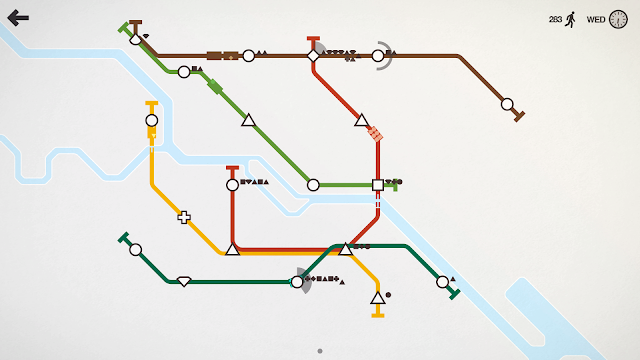
I'm a big fan of minimalist art styles in games - simple lines and shapes, dashes of color, the occasional complex geometry, etc. I like the way it looks, but there's more to an art style than just the way it looks. Mini Metro. Image from official press kit. Check out the GDC talk . Games have had a long history of trying to mimic reality, especially big-budget games made by large companies for mass audiences. It can be impressive to see how far technology has come, but basing games in realistic worlds runs counter to game design. Real life has a lot of limitations, and games based on real life have to devote a lot of effort to explaining why you can do things that can't be done in real life, or they blatantly ignore such conflicts and go for the "it's just game logic" option. Whether or not you care about immersion, this is a problem that wouldn't exist if the game wasn't based in reality. Rise of the Tomb Raider. Image from vg247.com. The pla...

What makes puzzle platformers challenging? What makes them good?

Image
I'm a big fan of puzzle platformers - games like Portal 1 and 2, The Talos Principle, The Swapper, etc. - and I've logged many dozens of hours playing such games, mostly due to community-made puzzles. In fact, I've played over 500 community maps for Portal 2, and I've learned quite a bit along the way. Someone asked me an interesting question that really got me thinking: When do elements that are individually passable become insurmountable or too convoluted when stacked together? It's a great question, and I think the answer depends on a few factors: how many options plays have at each step, which options players are likely to actually notice, and what players typically think about each option. Every player is different, but that doesn't mean you can't estimate the qualities of a puzzle without players. How many options does a player standing in the center of the room have? An 'option' is an action the player can perform to change the state o...

Fizzlers

Image
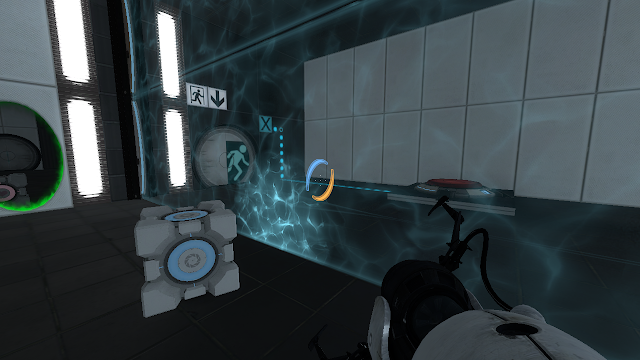
I haven't really studied game design much, but seeing as I want to make games, I figured I had better at least pay attention to the games I play and see what I can learn from their design. I've learned a lot of things about game design and a lot of things about myself - namely, I like puzzle games, and there's a trend in puzzle games that makes them more fun for me. I've recently been playing a lot of Portal. A lot. I've played Portal 1 , Portal 2 , Portal Stories: Mel , Aperture Tag , Rexaura , and many, many  community maps for Portal 2. (Though I have not played anywhere near as much as this guy ). One thing I have noticed consistently is that I enjoy fizzler puzzles - you know, those ones where one or more Aperture Science Material Emancipation Grills play a crucial role in the puzzle? A fizzler in Portal 2, with a nearby cube to show the effect. Fizzlers in Portal 2 allow you to pass through them, but they impose certain limitations. You cannot shoot ...

Why do people like puzzles with multiple solutions!?

Image
I've asked this question before and I still want to talk about it, because I still cringe when people mention it. I frequently notice reviewers and players complaining about puzzles with only one solution, saying they instead want puzzles with multiple solutions. I cannot wrap my head around why , as there are so many drawbacks both from the player's perspective and the designer's perspective. Why would people want this when it only subtracts from the experience? Having multiple solutions can either make a puzzle too easy, or too confusing. For example, the player often thinks that every part of the puzzle has a purpose (this is how our brains naturally work), but with multiple solutions, some parts of a puzzle might never be used for the solution the player uses, leading to confusion - red herrings may be enjoyable in some circumstances, but puzzles are not any of those circumstances. It is also significantly more difficult to design a proper puzzle with multiple sol...

"Garbage Collection is Wrong" Explained

My other website, LB-Stuff.com , has been the primary target for my sudden urges to write articles on various things. People keep calling them blog posts (they're not), so I finally decided to make an actual blog. I figured "Eh, I like writing, and it's more comfortable than verbal communication", so why not? The first article I wrote on my site was titled "Garbage Collection is Wrong". Yikes, what was 17-year-old me thinking? It was unintentional flamebait that ended with me having to put in a banner explaining that I didn't really know what I was talking about because I was just a teenager. Well, now I'm 20 and I still regret writing that article. I don't dare erase it, however. Sure, I often edit my forum posts dozens of times after submitting them and occasionally delete them mere seconds afterward (I am pretty impulsive sometimes and quickly regret the things I say), but I'm afraid that deleting the page would generate the wrong respon...